
Introduction
Modern backend systems are becoming increasingly complex. Applications today are expected to handle millions of users, process large volumes of data, and remain reliable even during failures.
To build scalable and resilient systems, developers rely on proven backend design patterns. These patterns help solve common architectural challenges in distributed systems, microservices, and cloud-based applications.
In this article, we will explore seven important backend design patterns every developer should understand.
1. Circuit Breaker Pattern
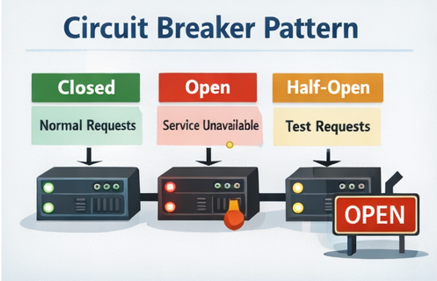
The Circuit Breaker pattern helps prevent cascading failures in distributed systems.
When one service becomes unavailable or slow, continuously calling that service can overload the entire system. The circuit breaker detects failures and temporarily stops requests to the failing service.
This pattern usually operates in three states:
- Closed – Requests are processed normally
- Open – Requests are blocked because the service is failing
- Half-Open – A few test requests are allowed to check recovery
Frameworks like Polly in .NET implement circuit breaker functionality.
2. CQRS (Command Query Responsibility Segregation)
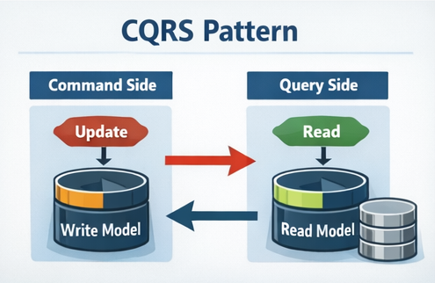
CQRS separates read operations from write operations.
Instead of using one model for both reads and writes, CQRS splits them into two different models:
- Command model – Handles updates and data modifications
- Query model – Handles data retrieval
This separation improves:
- Performance
- Scalability
- Maintainability
CQRS is commonly used in microservices architectures and event-driven systems.
3. Event Sourcing
In traditional applications, the database stores only the current state of data.
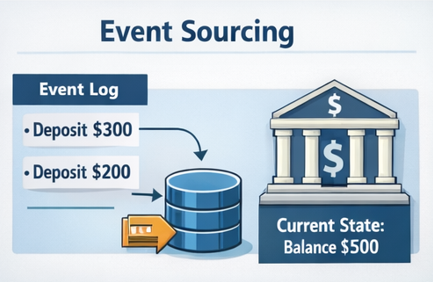
Event Sourcing takes a different approach. Instead of storing the final state, it stores all events that led to the current state.
Example:
Instead of storing a bank balance of $500, the system stores events like:
- Deposited $300
- Deposited $200
The current state can always be rebuilt from these events.
Benefits include:
- Full audit history
- Easy debugging
- Improved system transparency
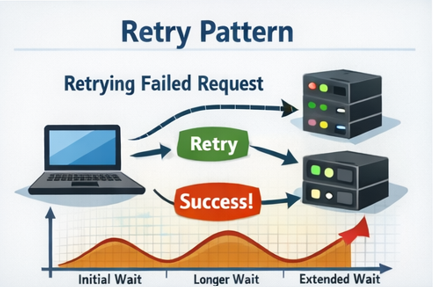
4. Retry Pattern
Temporary failures are common in distributed systems.
The Retry Pattern automatically retries failed operations when the failure is likely temporary.
Common scenarios include:
- Network interruptions
- Temporary database connection issues
- API rate limits
Retry mechanisms typically use exponential backoff to avoid overwhelming the system.
5. Saga Pattern
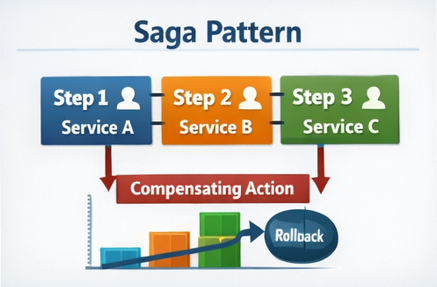
In microservices architecture, a single transaction may involve multiple services.
Traditional database transactions don’t work well across distributed services. The Saga Pattern solves this problem by breaking a transaction into smaller steps.
Each service performs its own local transaction.
If something fails, compensating transactions roll back the previous steps.
Saga can be implemented using:
- Choreography (event-based communication)
- Orchestration (central coordinator)
6. API Gateway Pattern
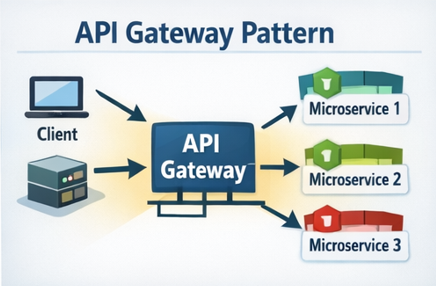
The API Gateway acts as a single entry point for all client requests.
Instead of calling multiple microservices directly, clients send requests to the gateway, which routes them to the appropriate services.
Benefits include:
- Simplified client communication
- Centralized authentication
- Request aggregation
- Rate limiting
Examples include:
- Kong
- NGINX
- Azure API Management
7. Service Discovery
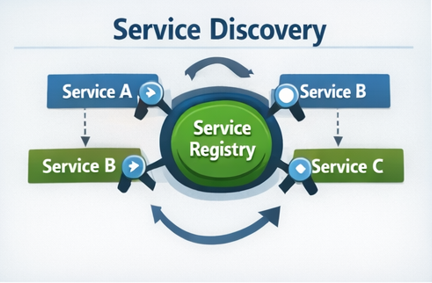
In microservices environments, services are constantly scaling up and down.
Hardcoding service locations becomes impossible.
Service Discovery allows services to dynamically locate each other using a registry.
Examples include:
- Consul
- Eureka
- Kubernetes service discovery
This ensures that services can communicate reliably even as infrastructure changes.
Conclusion
Backend design patterns play a critical role in building scalable, resilient, and maintainable systems.
Understanding patterns such as Circuit Breaker, CQRS, Event Sourcing, Retry, Saga, API Gateway, and Service Discovery helps developers design systems capable of handling real-world complexity.
As modern applications continue to evolve toward cloud-native and distributed architectures, mastering these patterns will become even more important for backend developers.